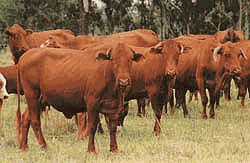
Africander cattle developed from the native Hottentot cattle of the Cape of Good Hope which are thought to have arisen from the longhorned Zebu and the Egyptian longhorn. The breed was first imported into Australia in small numbers in the early days of colonisation and re-introduced in the early 1950s via the USA when the CSIRO imported five bulls and two females to Belmont Research Station, near Rockhampton. The first release of stock to the public in Australia took place in 1960, when purebred bulls from Belmont Research Station were sold at open auction.
DISTRIBUTION
The breed is currently found in central and western Queensland but shows potential for other areas, particularly the arid and semi-arid regions of northern Australia.
BREED CHARACTERISTICS
The Africander is red in colour but may vary from light tan to a deep cherry red. The animals are horned, the horns being flesh to creamy white in colour, with amber tips. Like other Zebu breeds, the Africander is heat-tolerant and has the ability to do well under harsh conditions. Tick-resistance of the Africander is lower than that of the Brahman but superior to that of the European and British breeds of cattle and is quite adequate for most areas of northern Australia. The Africander has a good temperament and under extensive management conditions is easier to handle than the Brahman-derived breeds. Africanders are medium-sized with loose skin and large drooping ears. Bulls have the typical Zebu hump of muscle and fat which rises to 7 cm or more above the topline.The majority of Africander breeders place emphasis on the continued improvement of traits which are economically important, such as growth rate, tick resistance and fertility. Performance tests are generally incorporated with registration of bulls.
ORIGIN
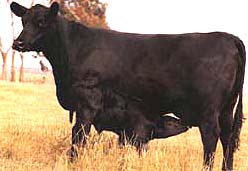
The Angus breed originated in Scotland from groups of closely related cattle breeds native to the shires of Aberdeen, Kincardine and Angus. The existence of these breeds goes back over 1000 years. First Australian imports were into Tasmania in the early 1820s and to the Darling Downs in Queensland in 1840.
DISTRIBUTION
Angus are popular in the higher rainfall areas of New South Wales, Victoria, Tasmania and Western Australia. Their numbers are increasing in northern Australia, and in other lower rainfall areas.
BREED CHARACTERISTICS
Angus are moderate-sized, muscular animals, renowned as a carcase breed. They are used widely in crossbreeding to improve carcase quality and milking ability. Angus is a preferred breed for the Japanese high-quality beef market because of their propensity to marble, their white fat and bright-red lean meat. A poll breed, they are also used as a genetic dehorner. They are solid black in colour but a small amount of white is permitted on the underline, behind the navel scar. Angus mature earlier than other British breeds. However, larger, longer and later maturing animals have been selected in some herds. In recent years, Australian breeders have developed a wider genetic base utilising genotypes from other countries through artificial insemination (17% of registrations) and embryo transfer (4% of registrations). The breed is renowned for ease of calving. Performance recording is widely practised. The breed was the first to produce a Sire Summary using the Group Breedplan genetic evaluation system. Many herds can provide buyers with Breedplan EBVs (Estimated Breeding Values) from Angus Breedplan and Group Breedplan
Ayrshire
ORIGIN
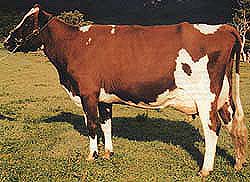
Ayrshires originate from the county of Ayr in the south-west of Scotland. Centuries ago a number of local farmers joined forces to breed a dairy animal suitable for the harsh conditions of the region. Years of development have resulted in a breed known the world over. The first Ayrshires were introduced into Australia in 1848 when Captain James Hutton arrived at Port Phillip Bay with a shipment for his cousins, the McNab family. It was from this original stock, particularly a cow called Annie, that the Ayrshire breed in Australia was founded. Further importations from Britain and New Zealand soon followed as the breed spread throughout the eastern States. In 1891 the Ayrshire Cattle Society was formed. The following year the first herd book was produced. Imported semen has also been very important to breeders’ programs in recent years, with the best genetic material continuing to be sought from the United Kingdom, Canada, New Zealand and Scotland.
DISTRIBUTION
BREED CHARACTERISTICS
The Ayrshire breed is typically of a medium size and frame with liveweights ranging between 450 and 480 kg. The Ayrshire Cattle Society offers a system of linear classification for registered cattle. This system involves a recording of measurable traits of conformation (such as length of rump, udder texture and depth of heel) on a scale of 1–9, representing the biological extremes of each trait. A classification rating and point score is arrived at through subjective assessment. The rating and points given are an indication of the animal’s overall conformation in relation to the ideals of the breed. Ratings can vary as follows: The breed’s coat colour can vary greatly from any shade of red or brown with white, mahogany and white, or almost plain white. Each colour is clearly defined. Ayrshires are also noted for well-conformed and well-attached udders with ideal teat placement. The breed has cast off its reputation for displaying an unfavourable temperament. This notoriety was possibly due to the prominent and somewhat dangerous horns that were a feature of the breed until dehorning became a widespread practice.
ECONOMIC FACTORS
FURTHER INFORMATION
ORIGIN
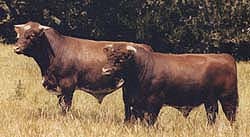
The breed was first introduced into New South Wales in the late 18th century and has developed into several distinct though closely related strains. These are the traditional Beef Shorthorn, the Poll Shorthorn, the Durham, the Dairy Shorthorn and the Australian Shorthorn. The Beef Shorthorn developed mainly in the safer rainfall areas of the country.
DISTRIBUTION
While many Beef Shorthorn herds are found in the lower rainfall areas as well as the safer rainfall areas of eastern and southern Australia, the breed has proved to be adaptable to all environments, including the Northern Territory.
BREED CHARACTERISTICS
Although colour ranges from red to roan to white, roan and red are the predominant colours. Beef Shorthorns are smaller in frame than are other Shorthorn strains and earlier in maturity. They have a truly rectangular shape and are horned. They are docile and are efficient foragers, best suited for the production of vealers and prime weaners. The carcase is usually prime at a young age because fat is laid down early.
ORIGIN
DISTRIBUTION
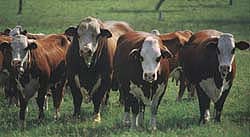
There are now well over 25 000 registered Brafords, mainly in Queensland and New South Wales.
BREED CHARACTERISTICS
The colouring of the Braford is similar to that of the Hereford, and the cattle may be polled or horned. In northern areas their coats are smooth and sleek, but in cool climates their coats tend to be thicker in winter. Some degree of Brahman inheritance is evident in their appearance, the breed having a hump, a low-set pizzle, a loose dewlap and droopy ears. Brafords are heat-tolerant and relatively tick-resistant. Carcases from the slightly larger and later maturing animals tend to be well muscled with a minimum of waste when slaughtered as yearlings and steers.
ORIGIN
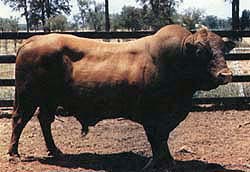
The Belmont Red has been developed in Australia by the CSIRO at the Belmont Research Station near Rockhampton. The breed as released by CSIRO comprised half Africander, quarter Hereford and quarter Shorthorn blood, but because of the upgrading system adopted by the breed society, herds that are developed in the industry will incorporate a proportion of genes from other breeds as well. Breeding commenced in 1956, with the first bulls being released for sale in 1968 and the first exports made in 1976 to Indonesia. Emphasis in the breed has been placed on objective selection for heritable and economically important traits such as growth rate, tick resistance, and fertility. Performance tests are compulsory for the registration of bulls.
DISTRIBUTION
The breed is found mainly in central and southern Queensland, with a few herds in other States.
BREED CHARACTERISTICS
The breed is predominantly red, with white markings at times, although some colour differences are occasionally evident. The cattle have good weight gain and good fertility. They are heat-tolerant, and while tick resistance is lower than that of the pure Bos indicus, it is still adequate. Belmont Reds are much more docile than the Brahman-derived breeds and under extensive management are easy to handle.
ORIGIN
DISTRIBUTION
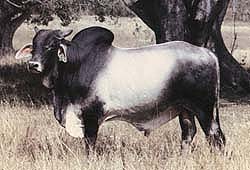
The Brahman has developed as a major beef breed in the tropical humid and subtropical dry areas, particularly in Queensland, north-eastern Western Australia, the Northern Territory and the north coast of New South Wales.
BREED CHARACTERISTICS
Brahmans are characterised by a hump above the shoulders and a pronounced dewlap. The coat is short and can be light to dark grey, various shades of red, or black. They show typical Bos indicus characteristics of shielded eyes, loose folds of skin on the dewlap and prepuce, and droopy ears. Brahmans are intelligent inquisitive and shy. The breed is medium in size with a tendency to later maturity, so carcases of young animals tend to be lean. The Brahman is suitable for crossbreeding, giving excellent hybrid vigour in the progeny. It has been involved in the development of stabilised crossbreeds including Braford, Brangus, Droughtmaster, Charbray and Santa Gertrudis.
ORIGIN
DISTRIBUTION
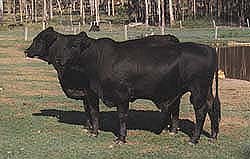
The breed is confined largely to Queensland and northern New South Wales, with small pockets in other States.
BREED CHARACTERISTICS
Brangus cattle are black or red, polled, with a sleek coat and pigmented skin. Their ears are medium to large and the skin is loose, with neck folds. The rump is slightly rounded, and the bulls have a moderate hump. The Brangus is a good forager, and the cows make excellent mothers with an ample supply of milk. Other features claimed are rapid weight gains, average to slightly late maturity and a carcase without excessive fat. Their ability to do well in the hot areas of the north and their resistance to ticks and bloat are important attributes.
Charolais
ORIGIN
DISTRIBUTION
Numbers of Charolais have rapidly increased since 1969, and today the breed and its crosses are found in most parts of Australia.
BREED CHARACTERISTICS
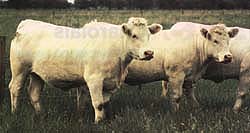
The breed colour varies from white to a light straw. They are large-framed animals, long-bodied, heavily muscled and late-maturing. Most Charolais are horned, though some polled animals are now being bred. Docility is a feature. Steers produced on good pasture yield heavy, well-muscled, fine-textured, though lean, carcases. Crossbred calves from good milking mothers can yield excellent carcases at 9 to 10 months of age.
ORIGIN
The Devon breed is said to be one of the oldest breeds of cattle in existence. The original Devon was prehistoric and thought to be descended from the original cattle in Britain. The breed was developed in Devonshire’s grass-covered hills in south-western England, and originally was bred for the high quality of its beef, though sometimes it was used as a dual-purpose type. A polled version of the breed, resulting from a purebred hornless mutant, dates back to 1915. It was first imported into Australia in 1800 by Captain John Macarthur and was used in the early days as a draught animal.
DISTRIBUTION
The Devon is found in moderate numbers throughout Australia, but particularly in the safer rainfall areas of south-eastern Australia.
BREED CHARACTERISTICS
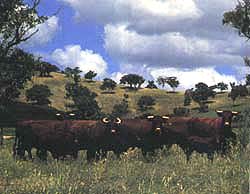
Colour ranges from deep red to pale chestnut, with darker red being the more popular colour. The skin is yellow and the muzzle flesh-coloured. The horns are of medium size and are creamy white, with the tips a darker shade. The Devon is a handsome animal with clear-cut lines and a blocky but symmetrical body. It is evenly fleshed, with good breadth and depth. Noted as a good forager, it is an early-maturing breed but is capable of producing finished carcases from calf through to heavyweight bullock.
Drought Master
BREED CHARACTERISTICS
Chianina
|
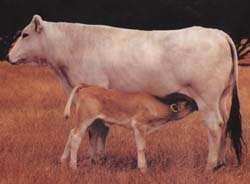
ORIGIN DISTRIBUTION BREED CHARACTERISTICS The Chianina is the largest of all cattle and is late-maturing, making it suitable for production of yearling and older beef. Carcases are muscular, lean and free from waste. Animals have a short, smooth, white coat with black skin pigmentation including a black tongue, palate, nose, eye area and switch. Horns are short, and in young animals are black, becoming white after two years of age. Calves are born fawn in colour and turn white between 30 and 260 days. The Chianina is a trim animal being uniform in depth and without excessive dewlap and brisket. It has strong legs, hard hooves and a small, refined head. Gestation periods tend to be longer than in British breeds, with twinning rates high though calves are usually born easily. The breed is known for its high heat tolerance. |
Hereford
|
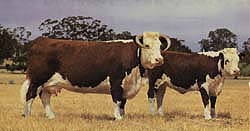
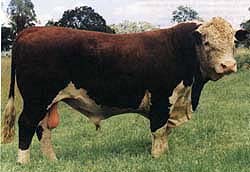
DISTRIBUTION BREED CHARACTERISTICS The Hereford colour is characteristic, with the body colour varying from rust brown to a deep rich red. Face, crest, dewlap, underline, switch and legs below the hocks are characteristically white. The distinctive white face tends to dominate in crosses with all other breeds and may have been a feature in establishing the breed’s popularity. Ability to do well on a wide range of pastoral conditions and to assimilate roughage, coupled with its good fertility, foraging ability and docility, account for its success. Depending on the level of nutrition and management, the breed can be produced as top-quality carcases ranging from heavy, marbled and fat, through to small, young and lightly finished. |
Holstein Friesian
DISTRIBUTION
BREED
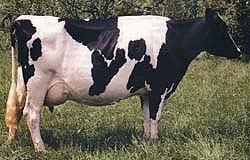
CHARACTERISTICSThe Holstein-Friesian is the largest of the dairy breeds, reaching an average mature weight of 550 kg. The Holstein-Friesian Association offers a detailed linear classification system for its registered cattle. It also conducts a linear type evaluation on non-registered artificially bred dairy cattle for various artificial breeding organisations participating in the Australian Dairy Herd Improvement Scheme. This system involves the recording of measurable traits of conformation (such as length of rump, texture of udder and depth of heel) on a scale of 1 to 9, representing the biological extremes of each trait. Classification ratings and scores vary as follows:
These are awarded through subjective assessment. This gives an indication of the animal’s overall type in relation to the ideals of the breed.
The breed’s colour is typically black and white, ranging from almost totally white to almost totally black. Red and white animals are occasionally found due to the presence of a recessive red factor in the breed.
Illawara
The breed can be found throughout all States of Australia, but is most popular in the coastal areas of NSW and the south-eastern corner of Queensland. Herd recording statistics (1987–88) show that 6.8% of all cows recorded in NSW were Illawarras.
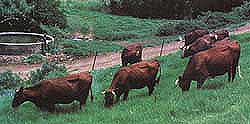
Illawarras have a relatively large upstanding frame, reaching an average mature weight of 480–500 kg. The Illawarra Cattle Society offers a system of linear classification for registered cattle. This involves the recording of measurable traits of conformation (such as length of rump, udder texture and depth of heel) on a scale of 1–9. These scores represent the biological extremes of each trait. A classification rating and score is awarded through subjective assessment. Coat colour is predominantly rich red, though some cattle are either roan or red with a little white on the flanks. White animals can result from the mating of roan bulls and cows, although they are a rare occurrence, as only 25% of the progeny from these matings will display this trait.
The breed is generally considered to have a placid temperament. Illawarras are tolerant of heat and, because of their dark pigmentation, have a very high resistance to sunburn and to skin and udder ailments compared with other dairy breeds.
Jersey
DISTRIBUTION
BREED CHARACTERISTICS
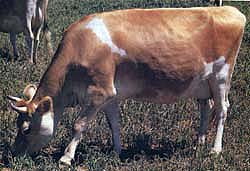
Jersey cattle are small-framed compared with other dairy breeds and are especially noted for their refined dairy type. The Jersey Breeders Society operates a linear classification system for registered cattle. Conformation traits (such as length of rump, texture of udder and depth of heel), are assessed objectively on a scale of 1–9. These scores represent the biological extremes of each trait. Liveweights of mature Jersey cows are typically around 350 kg. Their coat colour varies from light fawn to black, with or without white markings. The Jersey’s muzzle is black encircled by a light-coloured ring and its head possesses a characteristic dished appearance. The Jersey cow is an extremely placid animal, making it a popular choice as a house cow.
Limousin
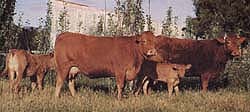
The Limousin is a rich gold colour, with lighter circles around the eyes and muzzle, and shading to a lighter colour on the legs. The skin is free of pigmentation. The head is small and short with a broad forehead, and the neck is short. Horns are yellow at the base and darken towards the tips; they are at first horizontal, then curve forwards and upwards. Smaller than the Charolais and maturing earlier, the Limousin is intermediate in size and maturity between British breeds and most other European breeds. Features of the breed are its hardiness, regular breeding, easy calving, good milking qualities, fast growth and the production of exceptionally high-yielding carcases with little fat.
Maine-Anjous
DISTRIBUTION
BREED CHARACTERISTICS
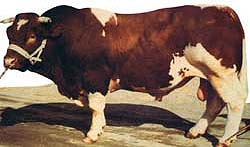
The Maine-Anjou is the largest of the French breeds. Although they are used for both meat and milk, they are best developed as beef producers. Their colouring is dark red and white, with the head always predominantly red and the eyes always surrounded by red colouring. They have medium-sized horns which curve forward like those of Shorthorns. The breed is noted for its rapid growth and weight gain, is late maturing, and produces a high proportion of well-marbled muscle with a minimum of fat cover and a large rib-eye area. Like the Durham, the Maine-Anjou has proven ability in crossbreeding with British breeds, producing very acceptable crossbred calves.
Murray Grey
|
DISTRIBUTION BREED CHARACTERISTICS
|
Poll Hereford
|
DISTRIBUTION BREED CHARACTERISTICS |
Romagnola
DISTRIBUTION
BREED CHARACTERISTICS
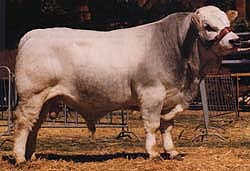
The Romagnola is similar in appearance to the Chianina and Marchigiana, though they are more compact, with well-fleshed shoulders and hindquarters and well-developed loins. The breed is well known for its relatively small calves and its ability to walk vast distances. The colour of the breed varies from white in summer to white-grey in winter, with dark shading around the neck, shoulders, limbs and tail switch especially in bulls. The skin is pigmented and the coat short but it grows longer in cooler conditions. Horns are black, but yellow at the base. Both bulls and cows have a prominent dewlap—the bulls more so than the cows. The breed is relatively late-maturing but has fast growth rates producing high-yielding, lean carcases. Romagnola bulls average 158 cm in height and weigh 1090 kg or more; mature cows average 145 cm and 635 kg.
Santa Gertrudis
DISTRIBUTION
BREED CHARACTERISTICS
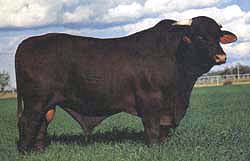
The breed is cherry red, occasionally with white markings on the underline, and has a short, smooth, slick coat. Santa Gertrudis cattle show many of the Bos indicus characteristics: the hide is loose and there are neck and navel folds; the male has a small Zebu-type hump. Ears are medium to large and individuals are horned or polled. The female is noted for ease of calving and milking ability. The breed is noted for heat tolerance as well as tick and bloat resistance. Carcases from very young cattle develop a large eye muscle of meat with little or no waste fat. Older steers yield well, with minimum fat cover acceptable to premium world markets. Weight for age is a noted attribute of the breed. Quality and uniformity in registered cattle is enforced by a rigid classification system by the breed association.
Simmental
DISTRIBUTION IN AUSTRALIA
BREED CHARACTERISTICS
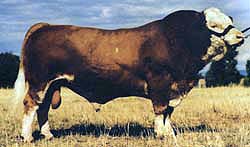
Simmentals vary from yellowish brown to straw colour to dark red, with white markings on the head, brisket, belly and legs. They often have red pigmentation around the eyes, and white patches on the body, especially behind the shoulders and on the flanks. Ideally the hair is soft and short. The breed is naturally horned although breeders are producing polled Australian purebred cattle. Simmentals are well-muscled animals, being long and deep-bodied with strong bone. They have good temperament and high milk production. Simmental carcases are significantly heavier and leaner than other European breeds, with little waste, and they give a higher yield of saleable meat. The breed is ideal for crossbreeding, particularly with Herefords, giving even lines of red and white cattle which can be selected to suit a range of markets.